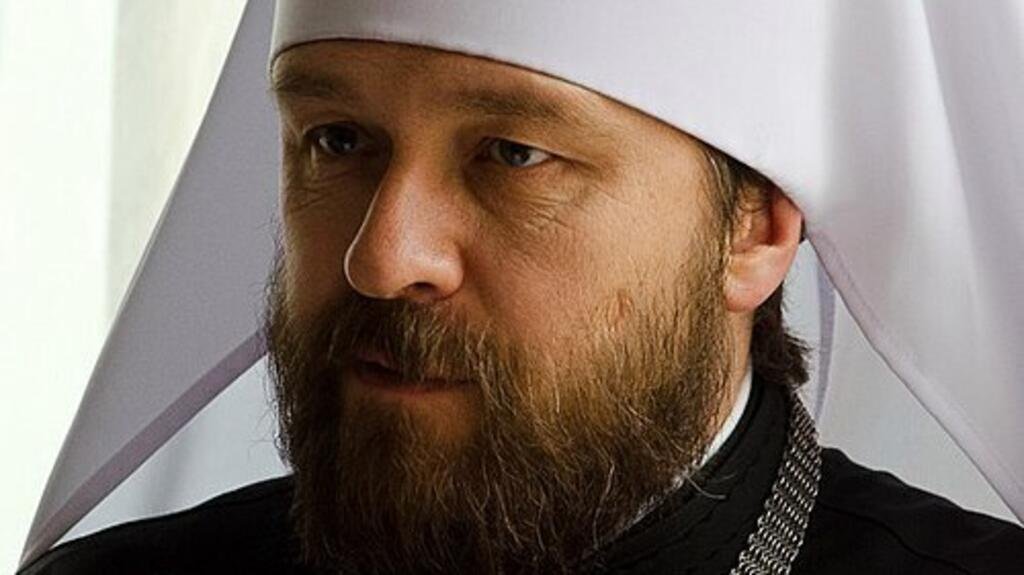
Moscow is calling the detention in the Czech Republic of Russian Orthodox Church Metropolitan Hilarion (Alfeyev) a “provocation” and is demanding his immediate release.
This was stated in a comment by Russian Foreign Ministry spokeswoman Maria Zakharova, according to the publication Vesti.
The ministry describes the case as a “fabricated investigation.”
“We demand the unconditional immediate release of Metropolitan Hilarion and the termination of the fabricated investigation,” Zakharova’s comment on the Russian Foreign Ministry website states.
According to her, Russian diplomats “will provide Metropolitan Hilarion with all necessary assistance.”
She stressed that “the accusations against Metropolitan Hilarion are far-fetched and constitute a deliberately staged provocation aimed at discrediting not only the clergyman himself but Orthodoxy as a whole.”
The Russian Orthodox Church also reacted to the detention of the metropolitan. Archpriest Igor Vyzhanov, deputy chairman of the Department for External Church Relations of the Moscow Patriarchate, called the case a “crude provocation.”
“Everything looks like a crude provocation. What is especially striking is its primitive and clumsy nature. It resembles a classic setup. It is well known that planting drugs is a favourite method of dishonest law enforcement officers around the world,” Vyzhanov commented.
As LF previously reported, Metropolitan Hilarion (Alfeyev) was detained by Czech authorities on 24 May in Karlovy Vary. During a search of the vehicle, four small containers containing a white substance were discovered in the luggage compartment.
LF Commentary:
As is well known, Metropolitan Hilarion headed the Department for External Church Relations of the Russian Orthodox Church until 2022, the branch of the Church that cooperated most closely with the Russian special services.
In 2022, he was removed from the post of head of the Department for External Church Relations of the Russian Orthodox Church. Many observers linked this to internal church politics and the war against Ukraine. However, his subsequent appointment, when he was sent to Budapest to head the Budapest and Hungarian Diocese, gave grounds to believe that he had effectively become Russia’s representative in dealings with Orbán’s friendly government.
The Insider and Re:Baltica wrote that in Hungary Hilarion may have served not only as a church intermediary but also as Moscow’s political intermediary in contacts with Viktor Orbán’s circle and Russian oligarchs. His former assistant, Georgy Suzuki, claimed that he had participated with him in meetings that resembled informal diplomacy in the interests of the Kremlin.
Hungarian national security expert Péter Buda openly advanced the view that Hilarion was closer to the Russian special services than to the Church.