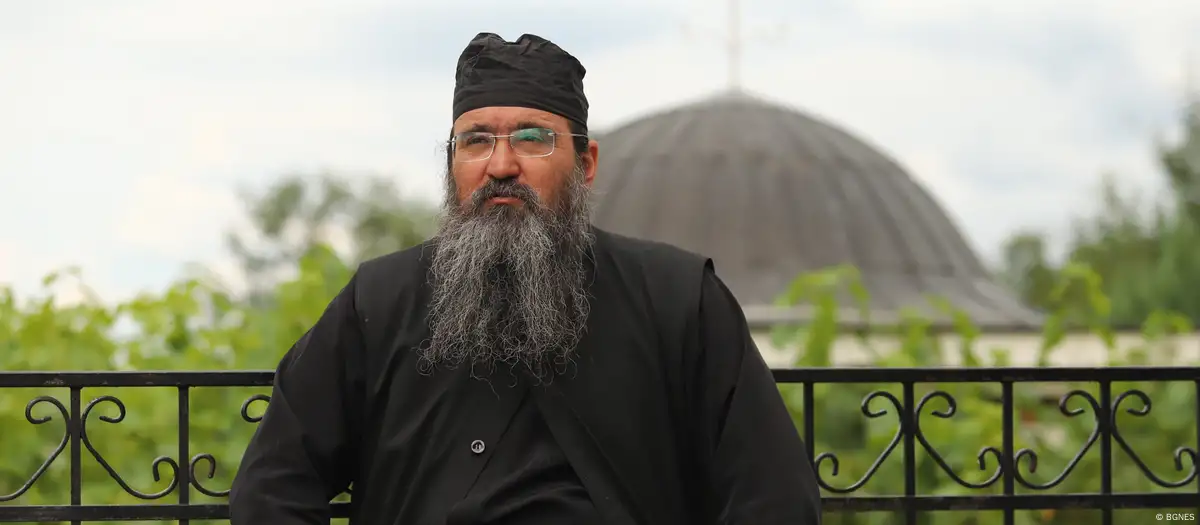
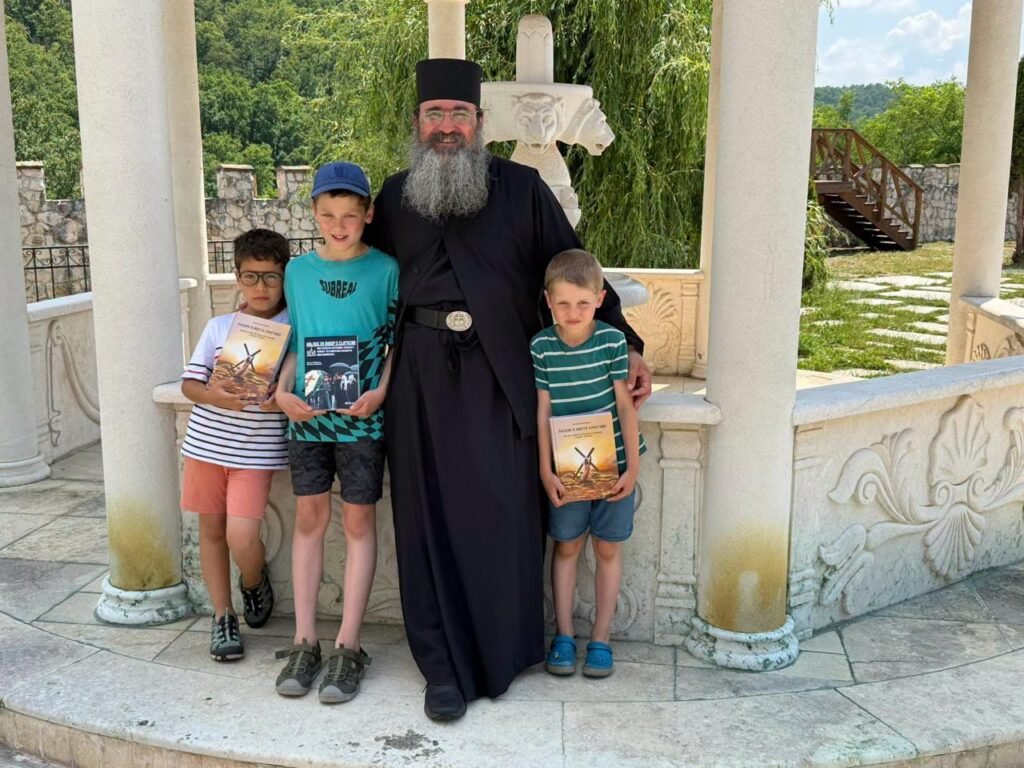
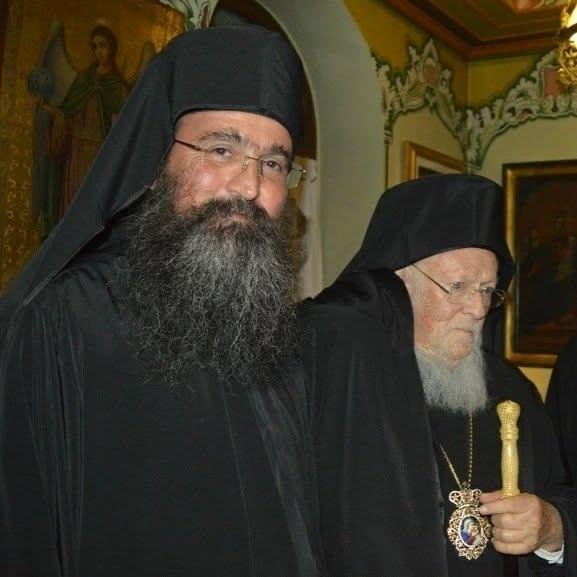
Archimandrite Nikanor is one of the best-known and most respected clergymen of the Bulgarian Orthodox Church and the abbot of the Monastery of Saints Cosmas and Damian. He is known for his independent stance, candid assessments of ecclesiastical and social developments, and his willingness to address the most controversial issues. His statements often provoke broad public debate, and his views are closely followed both within church circles and beyond. In this interview, Archimandrite Nikanor reflects on the future of Orthodoxy, Moscow’s influence on the Local Churches, Russia’s war against Ukraine, and the challenges facing contemporary Christianity.
— Father, the Churches of the Diptych, the pan-Orthodox list, are now divided into two camps. Some are friends and junior partners of Moscow, while others are commonly described as Hellenophiles and maintain unity with the Ecumenical Patriarchate. There is also a third group that seeks to preserve a balance but in practice benefits from Moscow’s financial support. Which of these groups does the Bulgarian Church belong to?
— Today all the Local Orthodox Churches, with the exception of the Moscow Patriarchate, remain in communion with the Ecumenical Patriarchate. Even the unrecognized autocephalous Church of North Macedonia is in Eucharistic communion with the Phanar. The Moscow Patriarchate, by contrast, has broken relations with the ancient Churches of Constantinople, Alexandria, and Cyprus, as well as with the Church of Greece. There is indeed a circle of Churches aligned with Moscow and supportive of its ecclesiastical positions, but none of them has dared to break Eucharistic communion with the Ecumenical Patriarchate. In that sense, the Bulgarian Church also belongs to this group. It appears to refuse recognition of the autocephaly of the Orthodox Church of Ukraine almost in defiance of the Ecumenical Patriarchate, while at the same time recognizing the Serbian “tomos” granting autocephaly to the Church of North Macedonia. Yet Bulgarian Patriarch Daniil also maintains very friendly relations with Patriarch Bartholomew. Such is the Byzantine complexity of church politics.
— The style of any patriarch’s leadership is often shaped by whether he studied in Moscow, received gifts there, or attained the patriarchal throne with Moscow’s support. Before his election, your Patriarch was known for promoting Russian narratives. Has anything changed?
— Nothing has changed. Our Patriarch remains a Kremlin asset. He wants to govern independently, disregarding the positions of the other bishops and very often acting contrary to the Church Statute and even civil law. He is not always successful because the Bulgarian Church is governed collectively by the Holy Synod. Just recently, without informing the Synod, Patriarch Daniil attempted to influence the Bulgarian government so that it would not support sanctions against Patriarch Kirill. However, at its meeting the Synod voted that sanctions are not a matter for the Church and effectively blocked the Patriarch’s initiative.
— One of our authors, analyzing why Bulgaria has sided with Russia on the issue of sanctions against Patriarch Kirill, wrote the following: “Bulgaria is one example of an unrealized historical longing for greatness. The problem is that turning back toward Russia does not bring greatness. It merely reproduces an old dependency in which a small country once again hopes to gain significance not through its own ideas, institutions, and projects, but through closeness to a foreign empire.” Do you agree that the position on Kirill reflects an attempt by a small nation to make its voice heard against the mainstream by using its old ties with Russia as a political instrument of self-expression?
— I think the author overestimates Bulgarian Russophiles. They are incapable of such sublimation. Historically, although Russian propaganda has been highly effective since the imperial period, Bulgarians as a whole have never been subordinate to Russia. Almost immediately after liberation from the Ottoman Empire by Russian arms, Bulgaria severed diplomatic relations with its liberator for ten years. During the First World War it fought against Russia and inflicted several defeats on Russian forces. Later, in 1940, when forced to choose between an alliance with Germany or the USSR, Bulgaria unhesitatingly chose Germany, although it did not wage war against the Soviet Union. The change came only after Bulgaria was occupied by the Red Army through repression and social engineering. Bulgarians were taught to love the Soviet Union more than their own homeland. In other words, the modern Bulgarian Russophile’s affection for Russia is simply rebranded affection for the Soviet Union. There have always been genuine Bulgarian nationalists, however, who deeply hated everything Russian.
— Will the Bulgarian Church eventually break away from Russia?
— Yes, when enough time has passed and there is a generational change. It will also happen when Bulgarians recognize that all of Russia’s friends in the Balkans have always hated them and continue to do so today. Just look at the frenzied anti-Bulgarian hysteria in North Macedonia. Its traces lead north to Belgrade and from there to Russia.
— In March 2018, Russian Patriarch Kirill, Vladimir Gundyayev, publicly rebuked Bulgarian President Rumen Radev in a sharp and patronizing manner.
— At that time our entire society was outraged by the Russian Patriarch’s behavior. It was a major diplomatic mistake on Kirill’s part. He seriously undermined Russia’s friends in Bulgaria.
— In 2023, Bulgaria’s State Agency for National Security expelled two priests of the Russian Orthodox Church. What is the situation now?
— After those priests were expelled from North Macedonia, the State Agency for National Security was compelled to respond because all operational activity had been conducted from Bulgarian territory. The Moscow Patriarchate’s representation church in Sofia is a major intelligence and coordination center, and preserving it became one of the highest priorities for the Russian services. That objective was achieved through the election of Metropolitan Daniil as Patriarch. Perhaps even over the dead body of Patriarch Neofit.
— How do you see the future of Orthodoxy in the Balkans? Is it fair to assume that Serbia will always remain pro-Russian? What are the prospects for North Macedonia and Montenegro to distance themselves from Moscow?
— Serbia will remain a Russian satellite for many decades, at least until the Serbs overcome their imperial ambitions and the trauma of defeat in the post-Yugoslav wars. North Macedonia and Montenegro are connected to Moscow through Belgrade. All Serbian influence in those countries is, in essence, Russian influence. Macedonian Russophiles fiercely hate Bulgarians. By contrast, those in North Macedonia who have positive feelings toward the Greeks also tend to view Bulgaria favorably. Montenegro will join the European Union before the others and will free itself from this nightmare more quickly.
— To what extent has the “Russian World” ideology penetrated the Balkans?
— In the Balkans, the “Russian World” takes the form of the “Serbian World.” However, Serbia has quarreled with all of its neighbors, and this “Serbian World” has too many enemies. Turkey alone is a formidable factor because it “will never abandon its own people” in Bosnia and Kosovo.
— How active is the Imperial Orthodox Palestine Society in the region?
— In the Balkans it operates under the name “Balkan Athonite Society.” Recently its activities have become far less visible. It seems to have frozen its operations. Apparently sanctions are working. No money means no “bursts of piety.”
— I would like to quote a recent interview you gave to a Ukrainian media outlet: “The new representative of the Moscow Patriarchate in our country, referring to Volodymyr Tishchuk, is a third-generation intelligence officer. His father held the same post in Sofia during the 1970s. He himself arrived here from the capital of espionage, Vienna, and behaves with extreme caution. Unlike his predecessors, he keeps an exceptionally low profile, stays away from publicity, and is almost invisible. His role appears to be to hold the line and prevent the so-called Russian Church in Sofia from passing completely into Bulgarian hands, a danger that arose at the end of 2023.” One of the central themes of our project is the connection between Soviet-era clergy and Soviet security services. We believe that if bishops publicly apologized, dependence on Moscow would disappear almost overnight. So far, however, only the late Metropolitan Chrysostomos and Patriarch Filaret have expressed public repentance. In Bulgaria, a commission was established in 1989 to investigate collaboration with the security services. When it published the files of bishops connected with State Security in 2012, it became clear that several serving metropolitans had collaborated with the socialist-era secret police. Were there public acts of repentance? In your opinion, how important is this issue? Can the former ties of these now elderly metropolitans still influence the direction of the country?
— Yes, some former State Security agents repented of their actions. Others, including one prominent theologian, still seek to present themselves as moral authorities for both the Church and society. As the saying goes, nothing is more brazen than a Bolshevik. Historical research has established that in 2011, of the fifteen metropolitans on the Bulgarian Holy Synod, thirteen had collaborated with Bulgarian State Security, one had been an agent of the KGB, and only one had no connection with these structures because he was too young. Despite the repentance expressed by a few informers, nothing really changed. All of them remained dependent on the shadow networks inherited from State Security. The threads still lead back to the Kremlin. To this day, it dictates every move of the Bulgarian Church.
— After the events of 2023 surrounding the Russian representation church in Sofia and the expulsion of representatives of the Moscow Patriarchate from Bulgaria, suspicions increased that church structures could be used as instruments of foreign political influence. In your opinion, how well-founded are the claims that Russian state institutions or intelligence services may interfere in personnel appointments and institutional decisions within Bulgaria’s Orthodox community?
— Not every Bulgarian bishop studied in Moscow’s theological schools. But every bishop who did study there eventually became a bishop. The rules have not changed. Even children attending Sunday school know that Moscow’s church institutions abroad function as intelligence outposts. What is difficult for an average Westerner to understand is the extent of the influence exerted by Moscow’s church structures on society. That is where all these “conservative” circles and defenders of “traditional values” come from. During the Soviet period, the KGB worked to divide Western societies. After the collapse of the Soviet Union, those specialists did not disappear. There was a brief pause during Yeltsin’s presidency, but later they became useful once again. This time, however, they operated not under the banner of world proletarian revolution but beneath church banners.
— Do the Bulgarian Orthodox Church and the Bulgarian state possess genuine mechanisms for distinguishing canonical ecclesiastical activity from politically motivated influence?
— The state lacks expertise in strictly canonical matters. In the past, the security services had a department responsible for church affairs, but it was closed long ago, and its functions were transferred to the department dealing with Russia. Had such expertise existed within the state authorities, President Radev would have received sound advice regarding sanctions against Patriarch Kirill. Instead, after consulting Patriarch Daniil, he encountered the first wave of public protests and contempt from Bulgaria’s Western partners. The Church certainly has the necessary mechanisms, but it will still do whatever the Kremlin instructs it to do.
— One final question that we ask everyone. Can the Church influence the course of a country? Can a single parish influence the life of a city or even the whole Church?
— Despite all the claims about its historic role in creating and strengthening Bulgarian statehood and national identity, the Bulgarian Church is, in reality, a marginal sect that has virtually no influence on the life of the Bulgarian people or on the actions of the government. It is often used by certain circles in power as a mouthpiece for propaganda that serves their interests. The Istanbul Convention is one example. Ultimately, the state rejected it. From the outside, it appeared that the Church had played the decisive role in that outcome. In reality, it merely announced a decision that had already been made.
Every parish can influence the life of its city or of the entire Church if its members live authentic spiritual lives, acquire the grace of God, and become more like God. That is entirely possible and within everyone’s reach.
Anna Jansone