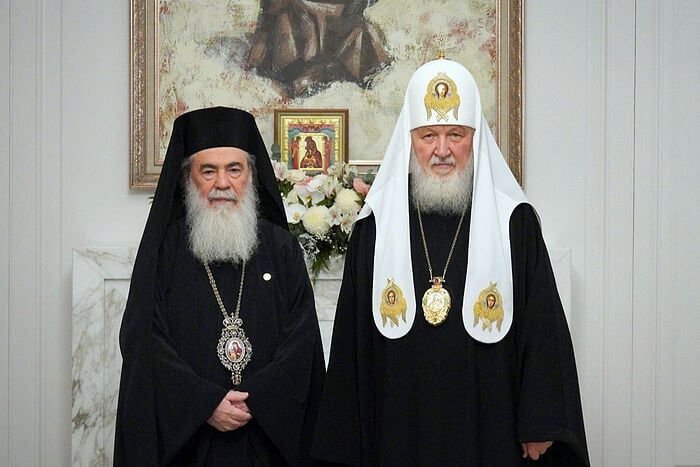
Russia directly finances the projects of the Patriarch of Jerusalem, Theophilos III, and Jerusalem has become one of the key centers of Kremlin influence. This situation may harm the State of Israel.
This is stated in an article by Michael Goldstein, published in The Times of Israel.
According to him, Jerusalem, as a crossroads of the three Abrahamic religions, is an ideal place for the expansion and projection of Russian influence at multiple levels. To legitimize its activities in other countries, Russia uses the interests of the Orthodox Church as cover.
The author describes the Kremlin’s efforts to legalize ownership rights to the Alexander Compound in the Old City of Jerusalem.
“It has long attracted the interest of the Russian government, as it is historically connected to the Russian Empire, which strengthened its power within the Ottoman Empire by building such centers of influence, and Jerusalem was part of that empire,” the author emphasizes, recalling that Russia managed to achieve the same with the Sergievskoe Compound. Moreover, the Jerusalem Patriarchate, led by Theophilos III, may become a key ally of Russia in this process.
If Russia succeeds in obtaining ownership rights to the Alexander Compound, this will create a number of risks for Ukraine and Israel. For Ukraine, this represents a geopolitical threat, as it may be interpreted as a symbolic legitimization of the Russian Federation despite its aggression, war crimes, and international isolation.
For Israel, these risks are no less serious. First, such a decision may lead to diplomatic tensions with European partners, who may view the transfer of a strategically important site to the Russian state as a concession to an aggressor country. From a security perspective, the strengthening of the Russian presence in the Old City creates potential opportunities for indirect influence, political maneuvering, and the use of this site in ways that contradict Israel’s interests, especially given the active role of the Russian Federation in Syria and its cooperation with Iran.
As the article notes, the Jerusalem Patriarchate does not conceal its ties with Russia. According to information on its official website, Orthodox Russia has traditionally supported it in matters of protecting holy sites and in relations among Christian communities.
According to the author, it is no secret that Russia directly finances the Patriarch’s projects, as he has repeatedly emphasized. There is eyewitness testimony about non transparent transfers of funds from representatives of the Russian embassy intended for the “needs” of the Patriarchate.
“Perhaps for Theophilos III this cooperation appears beneficial for global Orthodoxy and his Patriarchate and harmless for the State of Israel as a whole, but practice shows that public figures who are useful to Russia in a wide variety of fields become its most devoted agents, spies, and collaborators,” the author stressed.