The Parliamentary Assembly of the Council of Europe (PACE) states that the Russian Orthodox Church, led by Patriarch Kirill, is being used by the Kremlin regime as an instrument of Russian influence and is complicit in war crimes.
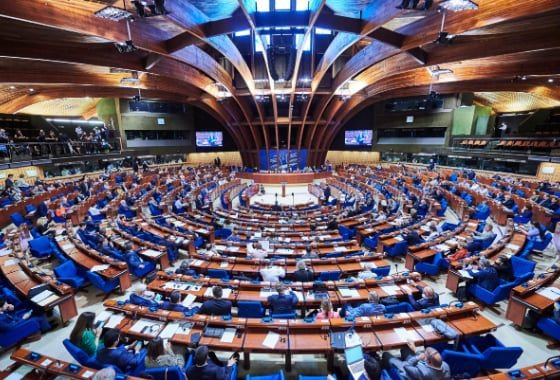
This is stated in PACE Resolution 2647 “Countering discrimination based on religion and protecting freedom of religion or belief in Europe,” adopted on 21 April 2026 at a session in Strasbourg.
The Assembly notes with particular concern that violations of freedom of religion or belief may be linked to situations of armed conflict and foreign occupation, in particular in the context of the Russian Federation’s war of aggression against Ukraine.
PACE states that religion is increasingly being turned into a weapon and used as an instrument of propaganda and hybrid warfare. Referring to Resolution 2540 (2024) “The death of Aleksei Navalny and the need to counter the totalitarian regime of Vladimir Putin and its war against democracy,” the Assembly reiterates its recognition that the Russian Orthodox Church is being used by the Kremlin regime as an instrument of Russian influence and propaganda. It notes that the hierarchy of the Russian Orthodox Church, led by Patriarch Kirill, functions as an ideological extension of the Kremlin regime and is complicit in war crimes and crimes against humanity committed on behalf of the Russian Federation and in the name of the ideology of the “Russkiy mir.”
Expressing concern over the growing manifestations of intolerance on religious grounds across Europe, PACE emphasised that freedom of religion or belief, including the right not to hold a religious belief or affiliation, “is not only a fundamental right, but also a vital element of any democratic system.”
PACE called on political leaders and public authorities to refrain from any instrumentalisation or misuse of religion or belief, in particular for electoral or other advantages.
By adopting a resolution based on the report by Francesco Verducci (Italy, SOC), the Parliamentary Assembly called on member states to ensure that religious communities and their members can exercise their right to freedom of religion without impediment or discrimination.
“No individual may be held responsible, on the basis of their religious affiliation or beliefs, for acts committed by others purportedly in the name of that religion or belief,” the parliamentarians stated.
In order to counter discrimination based on religion, the adopted resolution proposes a set of measures relating to research and data collection, as well as education, information, and awareness raising, aimed at teachers, public officials, law enforcement officers, and judges.