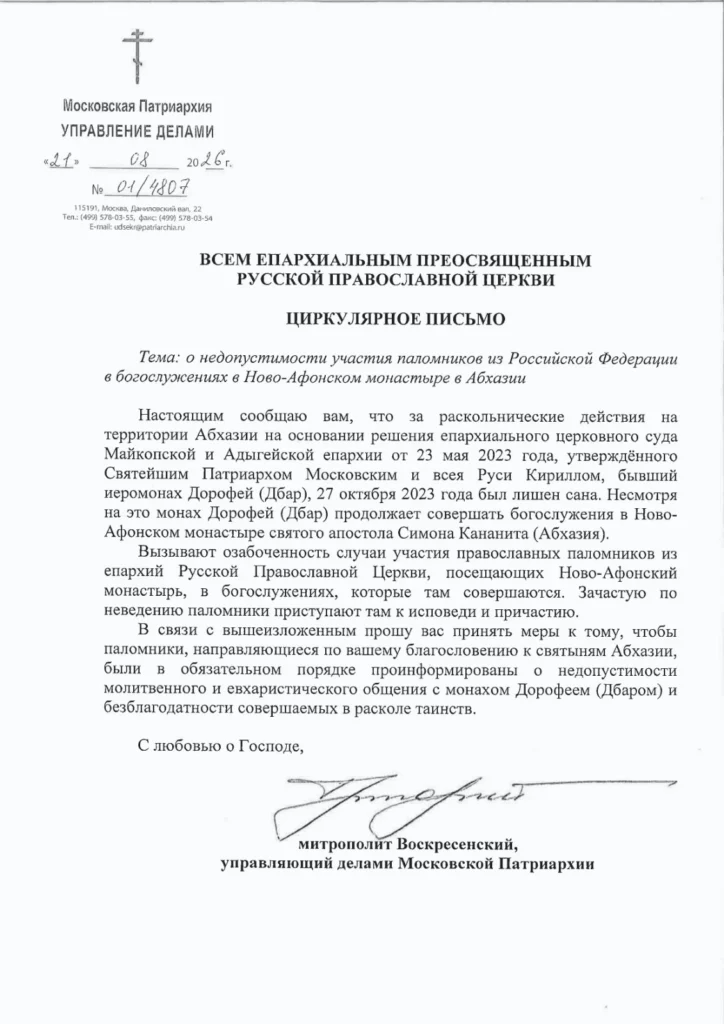
The Moscow Patriarchate has prohibited its faithful from participating in services at the New Athos Monastery in Abkhazia, where Archimandrite Dorofei (Dbara) serves.
Libertas Fidei obtained a circular from the Moscow Patriarchate instructing that Russian pilgrims be informed of this prohibition. At the same time, as early as 2013, Russian church structures had warned pilgrims that participation in the services of Dorofei (Dbara) and his supporters was impermissible.
As stated in an LF article, the document is evidence of how the Russian Orthodox Church maintains its influence over church life in occupied Abkhazia without formally incorporating it into its jurisdiction.
Abkhazia is part of the internationally recognized territory of Georgia and is under Russian occupation. From a canonical perspective, the Orthodox parishes of Abkhazia belong to the Georgian Orthodox Church. No Local Orthodox Church has recognized an independent Abkhazian Church. In practice, however, this canonical arrangement barely functions. The process of displacing Georgian clergy began in the 1990s, and after 2008 the Georgian ecclesiastical structure was almost entirely pushed out of Abkhazia.
“Georgian clergy cannot freely enter Abkhazia and conduct services there, including in areas where a significant Georgian population resides. At the same time, Moscow has formally refrained from incorporating Abkhazia into the Russian Orthodox Church. A far more subtle arrangement has emerged, control without formal ecclesiastical annexation,” the article states.
It also explains that the priest Dorofei (Dbara), who has been prohibited by the Russian Orthodox Church from exercising his ministry, is one of the most consistent proponents of the idea of an independent Abkhazian Church.
In May 2011, a church and popular assembly was held at the New Athos Monastery, following which the Holy Metropolis of Abkhazia was established. Dorofei (Dbara) became chairman of its Council and one of the candidates to become a future bishop. New Athos became the center of the movement.
Thus, a third path emerged. Not a return to de facto control by Tbilisi, but neither a gradual dissolution into the Russian ecclesiastical space. He advocated an independent Abkhazian Church, whose status should be resolved through an inter-Orthodox dialogue, including with the participation of Constantinople.