The Armenian conflict will show whether a state can dismantle Russian influence by force when that influence has for decades relied not only on political parties and security services, but also on religious institutions.
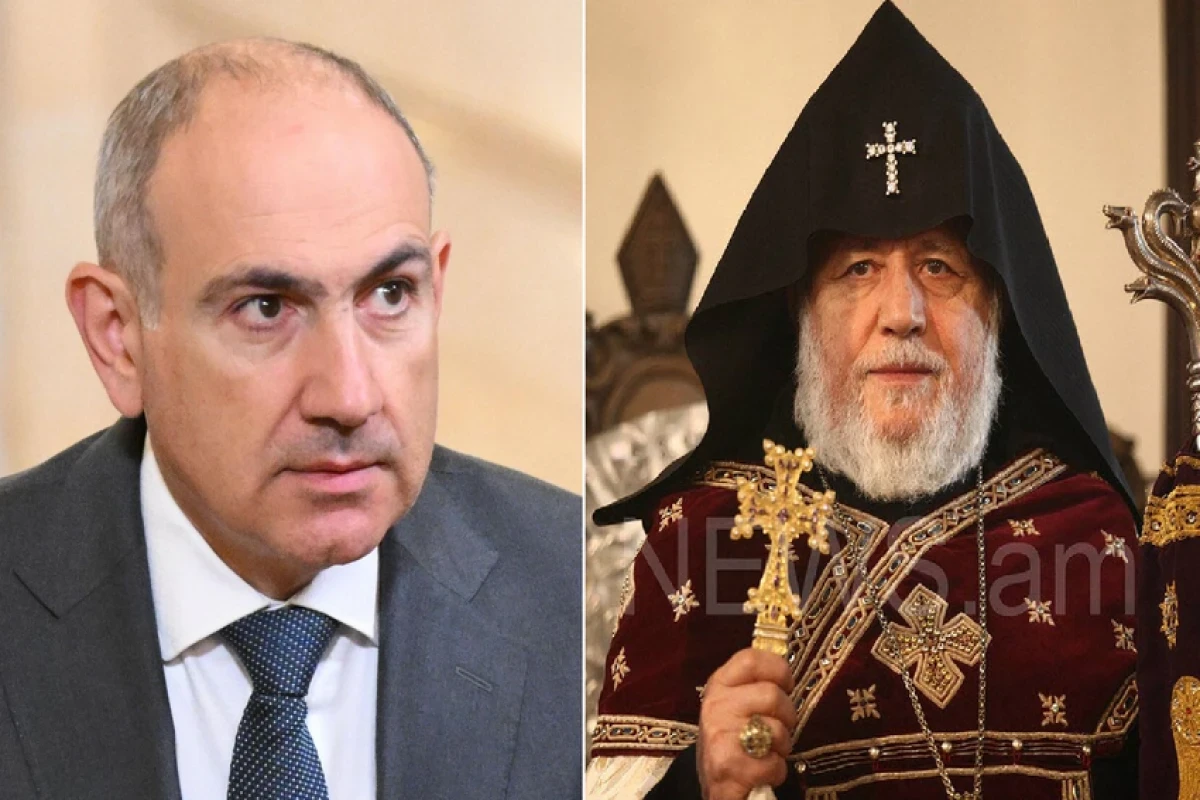
On August 28, 2026, another hearing was held in Echmiadzin, Armenia’s spiritual center twenty kilometers from Yerevan, in the criminal case against Catholicos of All Armenians Garegin II and six members of the Supreme Spiritual Council of the Armenian Apostolic Church.
The hearing was preliminary. The Catholicos himself was not in court, and the case has not yet reached a substantive examination of the charges.
But the political meaning of what is happening is far broader than the specific criminal charge.
The Armenian state has entered into open conflict with the leadership of the national church.
And this conflict is worth watching not only for Armenians.
This is one of the most interesting political experiments in the post-Soviet space: how far can a state go when it decides to break free from the Russian system of influence, if that system has for decades been embedded not only in the army, security services, and political parties, but also in national, cultural, and religious institutions?
And where is the line between the necessary protection of state sovereignty and dangerous government interference in the autonomy of the church?
That is precisely why the Armenian story matters to Europe.
Nikol Pashinyan’s conflict with the leadership of the Armenian Apostolic Church cannot be reduced to the prime minister’s personal dislike of the Catholicos.
It is part of a much larger process.
Pashinyan is dismantling the political structure on which Armenia existed for almost three decades.
It can be provisionally described by the formula:
Karabakh — Russia — the old political elite — the special political role of the Armenian Apostolic Church.
After the collapse of the USSR, Moscow became Armenia’s main military patron. Russia controlled a significant part of Armenia’s energy sector, maintained a military base in Gyumri, dominated the security sphere, and acted as the main external mediator in the Karabakh conflict.
Over time, this dependence came to be perceived almost as the natural condition of the Armenian state.
But in 2020–2023, the system collapsed.
In 2020, Armenia lost the Second Karabakh War.
In September 2023, Azerbaijan conducted a lightning military operation after which the unrecognized Nagorno-Karabakh Republic ceased to exist, and more than 100,000 Armenians left the region.
The Russian peacekeeping contingent deployed in Karabakh after the 2020 war did not stop the Azerbaijani operation.
For a huge number of Armenians, this became a moment of political awakening.
For decades, the country had built its security around an alliance with Russia, and at the critical moment that system failed to provide security.
This is where Pashinyan’s main foreign-policy turn begins.
Armenia is freezing its participation in the CSTO, expanding cooperation with the European Union and the United States, purchasing weapons from France and other countries, seeking to normalize relations with Turkey, and attempting to conclude a peace treaty with Azerbaijan.
This is not a cosmetic adjustment of foreign policy.
It is an attempt to leave the Russian political orbit.
And it is precisely here that Pashinyan encounters an internal system formed in an entirely different era.
With former President Robert Kocharyan.
With Karabakh political groups.
With major Russian-Armenian capital.
With political forces that regard the break with Moscow as a historic mistake.
And with part of the senior hierarchy of the Armenian Apostolic Church.
It would be untrue to call the entire Armenian Church “Moscow-aligned.”
The AAC is not subordinate to the Moscow Patriarchate and is an independent Oriental Orthodox church.
But the political ties between a significant part of its leadership and Russia have existed for a long time and are well known.
Garegin II himself maintained close relations with Russian state and church structures. His brother, Archbishop Yezras Nersisyan, heads the Russian Diocese of the AAC. The Russian authorities have traditionally regarded the Armenian church hierarchy as one of the most important channels for preserving influence in Armenian society.
At the same time, no evidence has been publicly presented that the Catholicos, or every bishop speaking out against Pashinyan, is a “Kremlin agent.”
And this is fundamentally important.
The problem is far more complicated than direct intelligence control.
Russian influence in the post-Soviet space rarely comes down to a person receiving a call from the Kremlin every morning and being given instructions.
It operates through a system of dependencies, social ties, historical perceptions, money, the media environment, elite contacts, and institutions that have an interest in preserving the old order.
It is precisely this order that Pashinyan is trying to destroy.
The overt politicization of part of the clergy became particularly evident after the loss of Karabakh and during the conflict surrounding the Armenian-Azerbaijani border.
In spring 2024, Archbishop Bagrat Galstanyan led protests against the demarcation of the border with Azerbaijan in Tavush. The movement quickly evolved from a regional protest into a nationwide campaign demanding Pashinyan’s resignation.
The archbishop became the de facto political leader of the opposition movement.
Later, a criminal case was opened against him, with the authorities accusing his supporters of preparing to seize power. Galstanyan rejects the allegations.
Another hierarch, Archbishop Mikael Ajapahyan, came under criminal prosecution after public statements about the possibility of removing the government by military means.
These are separate cases, and they cannot be mechanically conflated with the current proceedings against Garegin II.
The current charge against the Catholicos is formally much more prosaic: it concerns failure to comply with a court ruling in an internal church dispute.
But the political context cannot be ignored.
After Pashinyan’s party won the parliamentary elections in June 2026, the government included reform of the Armenian Apostolic Church in its 2026–2031 program.
In effect, the prime minister is demanding Garegin II’s departure and new elections for Catholicos.
Pashinyan demonstratively refers to him by his secular name, Ktrich Nersisyan, signaling that he no longer recognizes the moral authority of the current head of the church.
This is no longer an ordinary dispute between a politician and a clergyman.
The state authorities are effectively declaring that the current church system must be changed.
At the same time, Pashinyan emphasizes that he is not fighting the Armenian Apostolic Church as such.
He has allies within the church itself.
In January 2026, ten archbishops and bishops supported a declaration calling for the renewal of the AAC.
The majority of the episcopate, however, later remained on Garegin II’s side and stated that the state has no right to determine who should lead the church.
And this is where the Armenian experiment becomes genuinely dangerous and genuinely important.
Pashinyan may be right in his fundamental diagnosis.
The Russian system of influence in Armenia will not disappear merely because Yerevan has frozen its participation in the CSTO.
Moscow will seek to preserve its influence through the old political elites, business, media, civic organizations, diaspora structures, and any institutions capable of mobilizing people against the country’s geopolitical shift.
There is no reason why the religious sphere should automatically be considered exempt from such a struggle.
Russia itself has demonstrated for decades how effectively religion can be turned into an instrument of state policy.
The Russian Orthodox Church has become one of the elements of the Russian state’s ideological machinery and has publicly sacralized the war against Ukraine.
Therefore, the question of Moscow’s political instrumentalization of religion is entirely legitimate.
But this does not mean that every tough government measure automatically becomes legitimate.
This is where Pashinyan’s real test begins.
If the fight against Russian influence turns into a right for the government to decide who is worthy of being Catholicos, a dangerous logic emerges.
Today, the state is interfering in the church system because it considers its leadership to be a conduit for Moscow.
Armenia therefore has to prove two things simultaneously.
First, the state does have the right to protect itself from foreign political influence, even when that influence is exercised through institutions possessing enormous symbolic authority.
Second, the fight against that influence must proceed through the law, transparent evidence, and an independent judiciary.
And that is precisely why what is happening in Armenia is far more interesting than an ordinary conflict between a prime minister and a Catholicos.
Pashinyan is attempting something that almost no other post-Soviet country has managed to achieve: dismantling a Russian system of dependency not after a revolutionary collapse of the state and not after Russian occupation, but through a political course pursued within existing institutions.
His victory in the 2026 elections shows that a significant part of society gave him a mandate to continue this course.
Against the backdrop of what is happening in neighboring Georgia, the difference is particularly striking.
The Georgian authorities are moving ever deeper into conflict with the European Union and increasingly reproducing political models familiar from Moscow.
Armenia is moving in the opposite direction, from Russian patronage toward a European political and institutional model.
But a geopolitical turn in itself does not make a country free.
Freedom begins where a government is capable of defeating its external adversary and still restraining itself.
Therefore, the Garegin II case is not simply an Armenian church story.
It is a test of whether it is possible in the post-Soviet space to carry out genuinely radical decolonization from Moscow without reproducing Moscow’s methods inside one’s own country.
Anna Yansone